There's a statistic that gets quoted so often in marketing it's almost become background noise: acquiring a new customer costs five to twenty-five times more than retaining an existing one. You've probably heard it. What you might not have done is run the numbers for your own business to see what it actually means.
Let's do that. And let's do it in South African rands, for South African businesses, where the economics look slightly different from a San Francisco startup blog's assumptions.
Where the 5–25x number comes from
The range is wide because it varies dramatically by industry and acquisition channel. A café that relies on foot traffic and word of mouth has a much lower acquisition cost than a salon that runs Facebook ads. The Harvard Business Review research that popularised this figure found that even at the conservative end, 5x, the implication for small businesses is significant.
For context: if a new customer who visits your coffee shop for the first time represents R45 in revenue, and your acquisition cost (across all your marketing, word-of-mouth incentives, and time) is R30 per new customer, you're making R15 on a first visit. If that same customer comes back eight more times in a year, you've made R405 from an initial R30 investment. That's the retention multiplier.
The real cost of customer acquisition in South Africa
Most small businesses in South Africa don't run formal advertising. Their acquisition channel is a mix of: location (people walking past), word of mouth, Google discovery, and social media, usually organic, occasionally paid.
Even without paying for ads, acquisition isn't free. Your time building a social presence, the cost of a sign or a window display, the discount you give first-time customers: these all have a rand value. A realistic blended acquisition cost for a small SA business that doesn't spend heavily on advertising might be R25–R80 per new customer.
For businesses running Facebook or Instagram ads, that cost rises sharply. A well-managed Meta campaign targeting local customers might generate leads at R40–R120 per new customer, before any conversion friction. A poorly managed one can cost far more.
Free resource
Not sure what reward to offer?
The reward is the most important design decision in your loyalty programme. We've put together five proven reward ideas for South African independent businesses, with margin guidance and real examples.
See 5 reward ideasFree, no sign-up required
Why loyalty programmes are the cheapest retention tool
Retention tools range from "do nothing and hope" to sophisticated CRM systems. Most small businesses land somewhere in the middle by default: they try to give good service, hope customers remember them, and occasionally post on Instagram.
A loyalty programme is the most direct retention intervention available to an independent business. It gives customers a concrete, visible reason to come back. Every time they see their stamp progress (6 of 8, 7 of 8), they're reminded of your business and that they have something to gain from returning.
The psychology behind this is well-documented. The endowment effect, where we value things more once we feel we own them, applies to loyalty progress. A customer with 6 stamps doesn't want to "lose" those stamps by going to a competitor. The programme creates a switching cost that doesn't require you to undercut anyone on price.
☕ Real example
Infinity Coffee at Helderberg Nature Reserve in Somerset West ran their Lekka programme for 17 days and saw their repeat visit rate climb from 30% to 83%. That's not just a retention improvement. It's a direct reduction in acquisition pressure. When existing customers come back more often, you need fewer new customers to hit the same revenue.
The broadcast channel you don't know you need
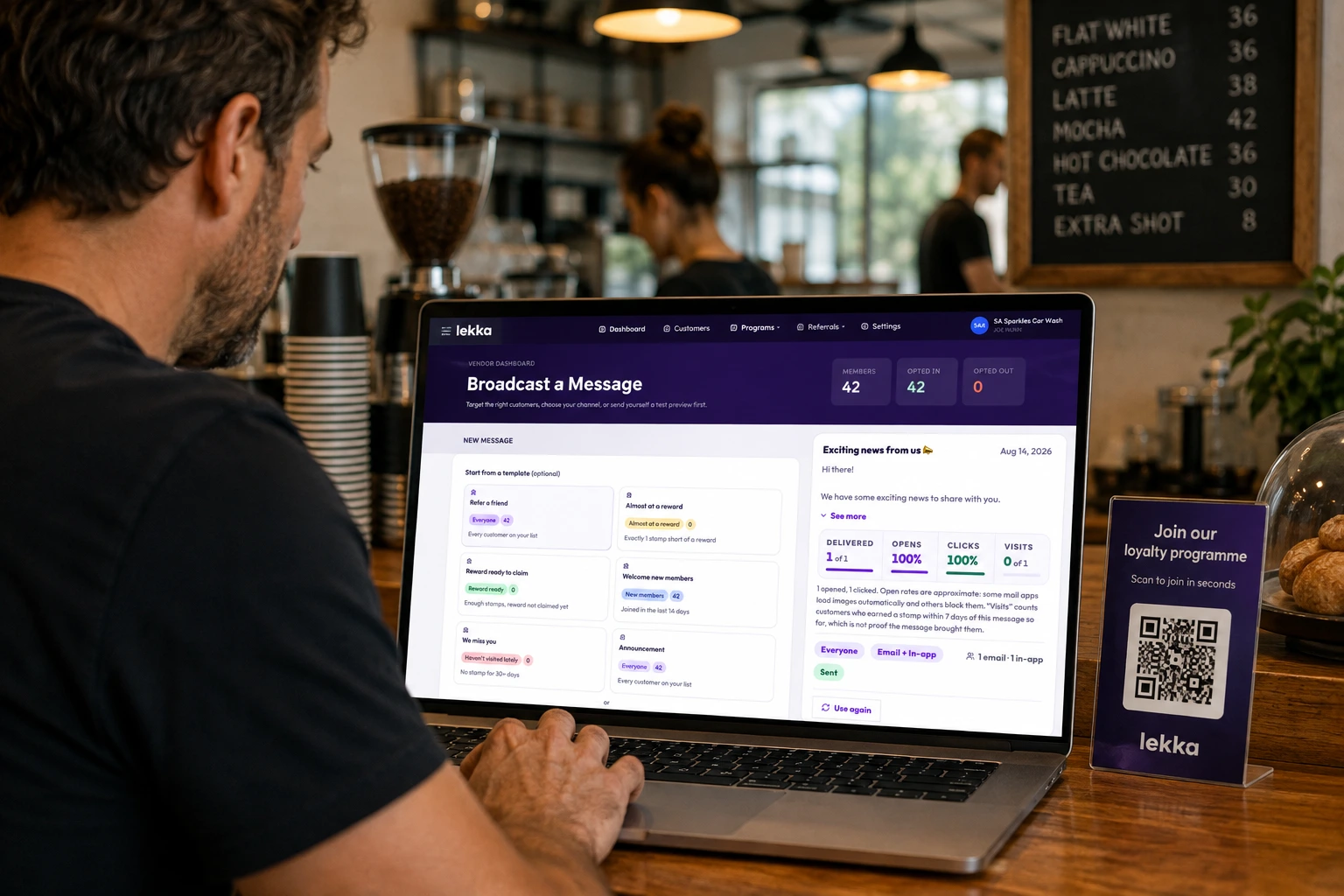
The retention benefit most businesses underestimate isn't the stamp mechanic. It's the communication channel. When customers join your loyalty programme, you have a way to reach them directly. You can send a broadcast when you have a slow Tuesday, a new product, a special occasion offer, or an event.
This is what large retailers take for granted and what most independent businesses completely lack. The Clicks database of loyalty members is enormously valuable not because of the stamps, but because it's a direct communication channel to people who have already bought from them.
You can build the same thing, at much smaller scale, with a digital loyalty programme. A base of 50 enrolled customers who've opted in to hear from you is worth more than 5,000 Instagram followers who may never see your posts.
What this looks like in practice
Take a hair salon with 120 active clients. If 60 of them are enrolled in a digital loyalty programme and return every 5 weeks on average, that's about 12 visits per client per year: 720 visits annually from the enrolled base alone. If the programme improves their return rate by even 10% (pushing average visits from 12 to 13.2), that's an extra 72 appointments from existing clients with zero acquisition spend.
At R350 per appointment, 72 extra visits is R25,200 in additional annual revenue. At a subscription cost of R249–R499 per month, the ROI is obvious.
The honest limits of retention strategy
Retention isn't a substitute for acquisition. It's a complement. If you have no customers, there's nobody to retain. Every business needs a pipeline of new customers, and a loyalty programme won't generate them on its own.
What retention strategy does is change your growth equation. Instead of spending heavily to constantly replace churned customers, you build a stable base that generates recurring revenue, and from that stable base, every new customer you acquire is genuinely additive rather than replacement.
The best-run independent businesses in South Africa aren't just good at marketing. They're good at keeping the customers they already have. A digital loyalty programme is the most accessible tool available to make that happen.