South Africa is one of the most loyalty-saturated markets in the world. According to the 2025/6 Truth & BrandMapp Loyalty Landscape Whitepaper, the most comprehensive annual study of SA consumer loyalty habits, 85% of South Africans now actively use loyalty programmes. That's up from 67% a decade ago.
But when small business owners ask whether loyalty programmes work for them, that statistic alone doesn't answer the question. Clicks has a multimillion-rand operation behind their ClubCard. You have a counter, a QR code, and a business to run.
So let's be direct: what does the evidence actually say, and what should you realistically expect?
What the data tells us
Loyalty Card
Corner Cafe
Coffee Rewards · Helderberg
Your stamps
Your reward
Free flat white
A Lekka digital loyalty card: what your customers would see on their phone.
The demand for loyalty programmes in South Africa is clearly there. But the same data shows something important: cashback and instant rewards dominate. Loyalty cards in South Africa that win, such as Clicks ClubCard, Checkers Xtra Savings, and Shoprite Xtra Savings, all deliver tangible, immediate value.
That has an implication for small businesses: a complicated points system with a distant payoff won't cut it. The loyalty programmes that work in South Africa are simple, clear, and deliver something real.
The case for small business loyalty programmes
The strongest argument for running a loyalty programme as a small business isn't about matching the big chains. It's about retention.
Acquiring a new customer costs significantly more than retaining an existing one. A loyalty programme, even a simple digital stamp card, gives your regulars a reason to choose you over a competitor. It creates a small psychological commitment: "I've got 6 stamps already, I'm not going to throw that away."
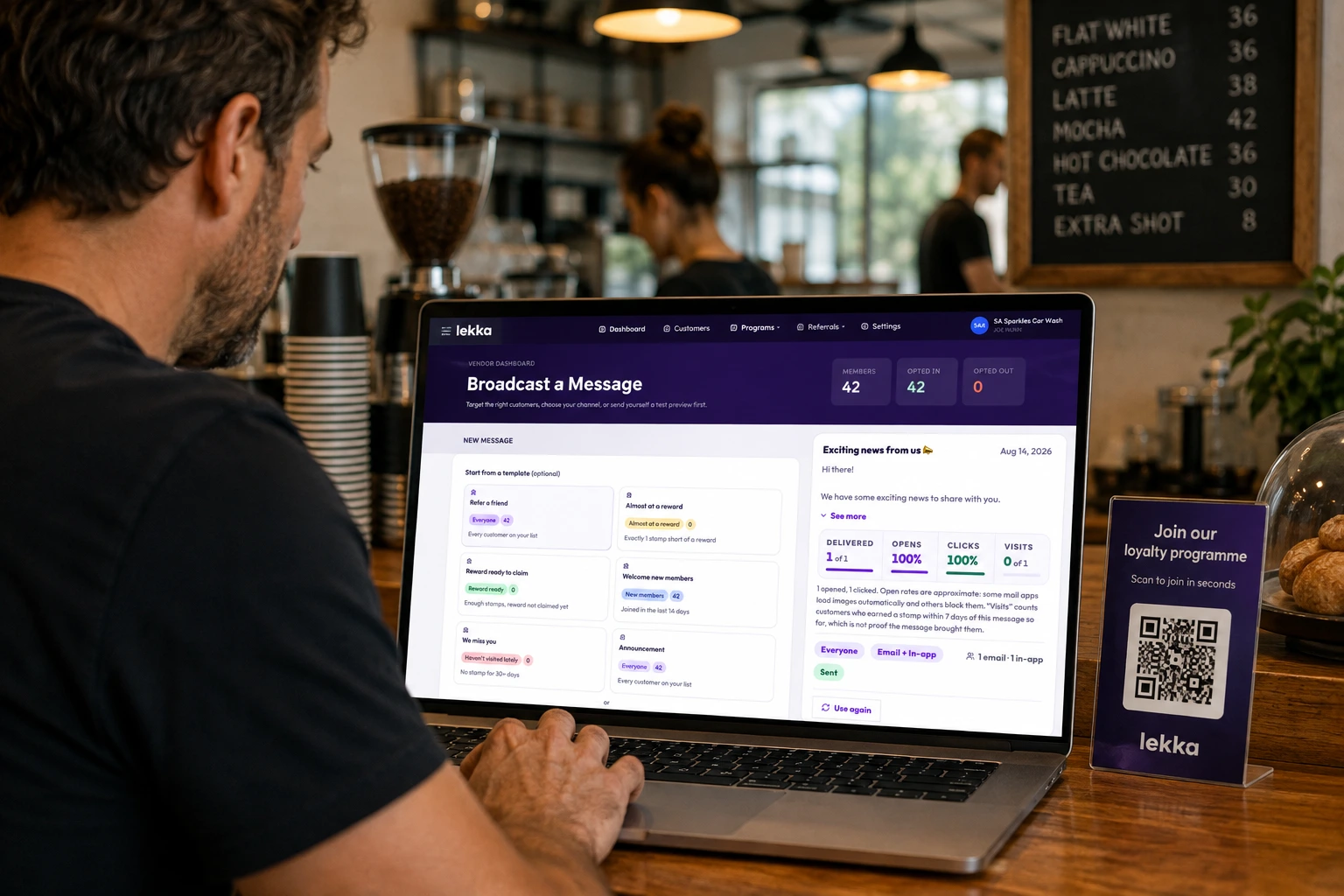
The second argument is communication. When you have customers enrolled in a programme, you have a direct line to them. You can send a broadcast when you have a special, a new product, or an event. That kind of direct reach is hard to build any other way without a big advertising budget.
☕ Real example
Infinity Coffee at Helderberg Nature Reserve in Somerset West runs a Lekka digital stamp programme. Customers scan a QR code at the counter, collect stamps, and earn rewards. The team can broadcast to their loyalty base whenever something's on.
The case against, and how to address it
Loyalty programmes can fail in a few predictable ways. Here's what to watch for:
- ✓Too complex. If customers can't understand the reward in 10 seconds, they won't join. Keep it simple: stamp X times, earn Y.
- ✓Too long to pay off. If the reward is 20 stamps away, it feels unattainable. Most successful stamp programmes sit at 6–10 stamps.
- ✓Too much friction to join. If customers need to download an app, they won't bother. A browser-based QR code flow removes this barrier entirely.
- ✓No promotion. A loyalty programme that nobody knows about is worthless. Put the QR code where people can see it and talk about it.
Free resource
Not sure what reward to offer?
The reward is the most important design decision in your loyalty programme. We've put together five proven reward ideas for South African independent businesses, with margin guidance and real examples.
See 5 reward ideasFree, no sign-up required
What kind of businesses benefit most
Loyalty programmes work best where the purchase is repeatable and frequent. Coffee shops are the obvious example: a daily or near-daily purchase with a natural stamp cadence. Hair salons, barbers, and nail bars also benefit strongly, even though the gap between visits is longer.
Restaurants, bottle stores, delis, health shops, and independent retailers are all good fits. The common thread: customers could choose to go somewhere else, but they'd prefer to come to you, and loyalty gives them a concrete reason.
Businesses that don't benefit much are those where purchase frequency is low (a furniture shop, for instance) or where the decision is almost entirely price-driven with no brand attachment.
The honest conclusion
Yes, loyalty programmes work for small businesses in South Africa, but only if they're simple, the reward is meaningful, and you actually promote them. A digital loyalty card app with a clear, achievable reward and a QR code at the counter is the lowest-effort customer loyalty programme available to an independent business.
The advantage you have over the big chains isn't scale. It's relationships. You know your customers. Loyalty technology is just a way to formalise and extend those relationships.