Most small businesses ask for Google reviews in one of two ways. They put a little card next to the card machine. They write 'please leave us a review' on the bottom of the receipt. Some of the more determined owners actually ask out loud, at the till, while the customer is putting their card away.
These approaches share something in common: they almost never work. The conversion rate is somewhere between 1% and 3% of customers, depending on who you ask. For a busy café that serves 200 people a day, that's perhaps two or three reviews a week, and only if you remember to ask, and only if the customer remembers to follow through after they leave.
There's a better moment. It's not at the till. It's not in the receipt. It's a few seconds after a customer has earned a stamp on their loyalty card, when they're holding their phone, looking at a screen that just told them they're closer to a reward. That moment converts at five to ten times the rate of the till ask. Here's why.
Why asking at the till barely works
The till is the worst place in the customer journey to ask for anything beyond payment. The customer is doing two things at once: completing a transaction and starting to think about leaving. Their phone is in their pocket. Their attention is on the bill, the card machine, the next thing they have to do today. Asking them to stop, take out their phone, find your business on Google, and write something positive is asking for several distinct actions in the worst possible moment.
There's also a psychological mismatch. Paying for something is a small loss: money out, even when the experience is good. Reviews work best when the customer feels they've gained something, not given something up. The moment of payment is the opposite of the moment they should be asked to advocate for you.
The peak-end rule
The Nobel laureate Daniel Kahneman spent a career studying how people remember experiences. One of his most well-known findings is the peak-end rule: our memory of an event is shaped overwhelmingly by two moments: the most emotionally intense point, and how it ended. The rest fades. The peak and the end are what stays.
In retail, the end is usually the till. That's why so much energy goes into making the goodbye feel warm. But the peak is something else entirely. The peak is the moment when the customer feels the most: when something delights, surprises, or rewards them. Reviews left at the peak read differently from reviews left at the end. They are warmer, more specific, more likely to mention what made the experience good. They are also far more likely to be five stars.
A loyalty stamp is a peak moment
Earning a loyalty stamp is a small but real win. The customer pulls out their phone, scans the QR code, and watches a confirmation screen tell them they now have five stamps, or seven, or ten: that they're closer to a free coffee or a discount or whatever the reward is. The dopamine hit is small but consistent. Progress feels good. Earning something feels good. Watching a number tick up feels good.
Even better, the customer is already on their phone. The friction of writing a review (open phone, find business, leave review) has been cut down to one tap. If a CTA appears on the same screen as the stamp confirmation, pointing straight at the Google review page for your business, the gap between intent and action is almost zero. That gap is where most review asks die. Removing it changes the conversion rate.
☕ Real example
An Infinity Coffee customer scans their QR code, sees 'Stamp added! 7 of 10' on the screen, and immediately below it: 'Enjoying Infinity Coffee? Tap to leave a Google review.' One tap opens Google's star picker for their listing. The whole interaction takes ten seconds.
Why Google reviews matter more than they used to
Google reviews have quietly become the most important marketing asset a local South African business owns. When someone searches 'coffee shop near me' or 'hair salon Sea Point', Google's local pack (those three businesses that appear at the top of the search results with a map) is what determines who gets the call. The ranking of those three businesses is determined largely by two things: proximity, and reviews.
Reviews count in two ways. First, the count itself: a business with 80 reviews ranks ahead of a business with 12, all else being equal. Second, the rating: a 4.7 average outperforms a 4.2 on the same query. For an independent business competing against franchises, this is one of the few places where consistent local effort beats marketing budget. A small café with 150 enthusiastic reviews outranks a chain branch with 30 lukewarm ones, every time.
How to use the loyalty moment in practice
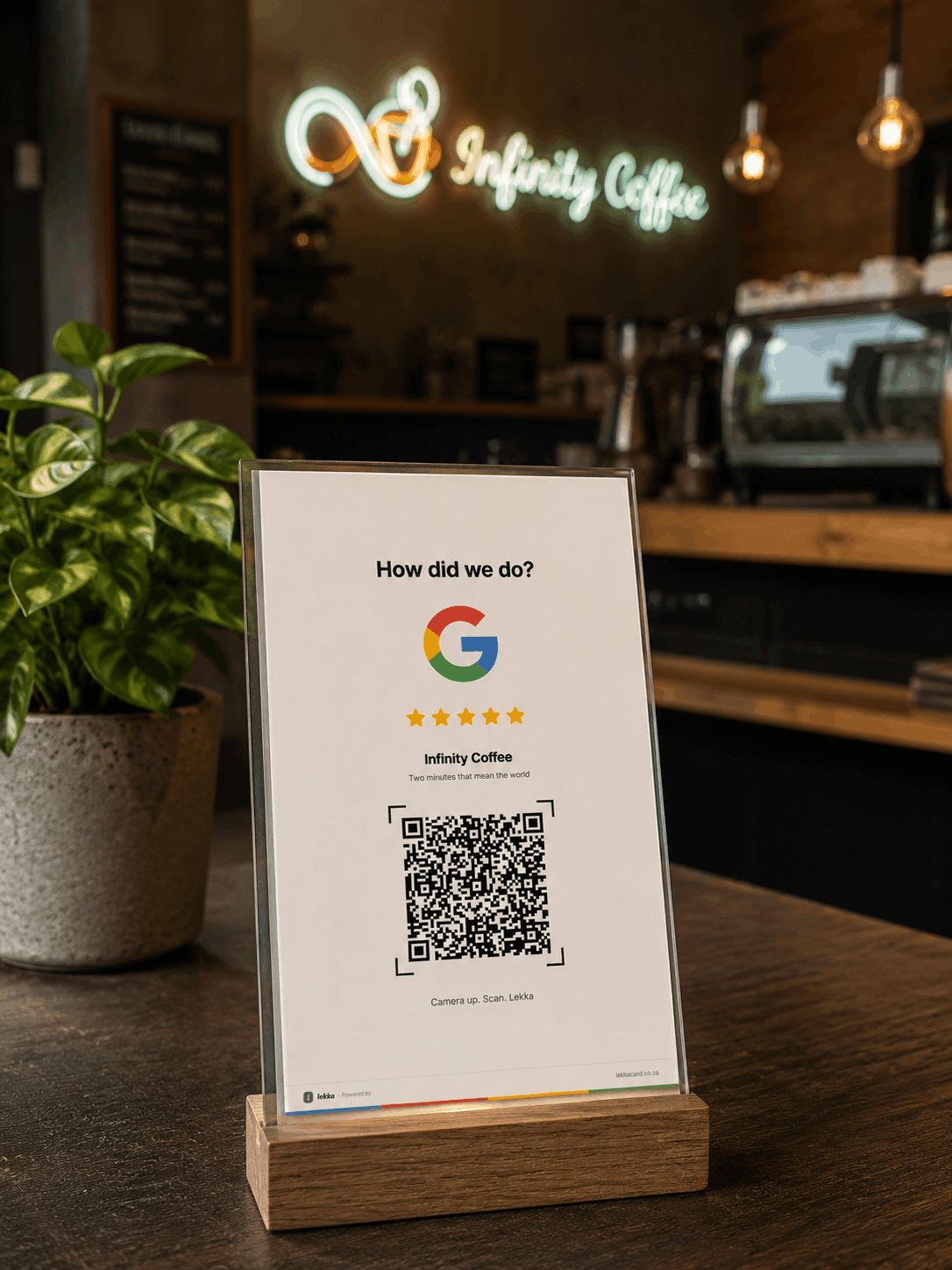
On Lekka, vendors can switch on a feature called Google Review Canvassing. Once enabled, every customer who scans a stamp sees a 'Leave a Google review' prompt on the success screen, deep-linked to the business's Google listing. The same CTA appears in the email that confirms the stamp was added, so a customer who taps away can be reminded later when they're back at their phone.
There's no extra work for the business. The CTA only requires one piece of configuration: the business's Google Place ID, pasted into the settings page once. From then on, the prompt fires automatically on every successful stamp scan, across every customer, with no need to remember to ask. The till ask is human-powered and inconsistent. The stamp moment is automated and consistent. That difference compounds over months.
Free resource
Turn your loyalty moments into Google reviews
Google Review Canvassing is a premium Lekka feature that surfaces a one-tap review prompt right after a customer collects a stamp, and in the confirmation email. Set up takes a single Place ID.
See how Lekka worksFree, no sign-up required
A few rules to follow
There are some best practices worth respecting when you ask for reviews systematically. Google's policies are clear, and breaking them can get a business penalised, or, worse, get the listing suspended.
- ✓Ask everyone, not just happy customers. 'Review gating' (where you only send the request to people who indicated they had a good experience) is against Google's guidelines. The loyalty moment self-selects: customers who are coming back for stamps are, by definition, customers who chose to return.
- ✓Never offer a reward for a review. You can't say 'leave us a five-star review and get a free coffee'. That's review buying and Google will flag it. The Lekka prompt doesn't tie the review to the loyalty reward. It simply uses the loyalty moment as the trigger.
- ✓Don't ask too often. The current Lekka prompt fires on every stamp by default, which is fine for most vendors. If you find regulars are tuning it out, frequency capping is something to consider, though usually the issue resolves itself once your most enthusiastic customers have left their review.
- ✓Make the link one tap. The deep link that Google provides for review writing goes straight to the star picker. No search, no scroll. If your prompt makes the customer do more than tap once, you'll lose 80% of them at that step.
Loyal customers, repeated asks, compounding results
Here's what often surprises business owners when they switch this on: the reviews don't all come at once. Some customers leave one the first time they see the prompt. Some leave one the third or fourth time. Some never do. But because the prompt is automated and tied to every visit, the cumulative effect is a steady drip of reviews from the people who like you the most.
Over a year, a busy café running this feature can reasonably expect to add 100 to 300 reviews to its Google listing, most of them four or five stars, most of them mentioning what makes the business specifically good. That's the kind of asset that genuinely changes how a business shows up in local search. It's not a marketing campaign. It's a system. And it works because it asks the right people, at the right moment, with no friction in the way.
If you're already running a loyalty programme, you already have the perfect moment. Use it.