The first question most business owners ask is not "will it work?" It's "what will it cost me?" That's the right question. A loyalty programme that costs more than it generates in retained revenue is not a programme, it's a subscription to feel good about yourself.
In South Africa, loyalty programme costs vary enormously depending on what kind of solution you choose. Let's break down the main options honestly.
Option 1: Paper stamp cards
Printing 200 paper stamp cards costs roughly R150–R300 from a local print shop, depending on card stock. A rubber stamp or sticker set adds another R50–R100. Total upfront cost: under R500.
The hidden costs are harder to see. Every lost or forgotten card is a reward you paid for with no result. There's no customer data: you don't know who your regulars are, how often they visit, or who's close to a reward. You can't communicate with your loyalty base because you have no way to reach them. And there's no way to measure whether the programme is driving repeat visits or just rewarding people who would have come back anyway.
📌 Note
Paper stamp cards aren't bad. They're just limited. For a very small operation with 20 regular customers and no growth ambitions, they're fine. For any business that wants to understand and grow its customer base, they hit a ceiling fast.
Option 2: Enterprise loyalty platforms
At the other end of the spectrum sit platforms built for large retail chains and franchise groups. These can cost R5,000–R20,000 per month or more, often require hardware (NFC terminals, dedicated card printers), need IT setup, and come with onboarding fees and long contracts. They're designed for businesses with hundreds of locations and sophisticated CRM needs.
If you're a coffee shop, a salon, or an independent retailer, these platforms are not built for you, and their pricing reflects that.
Option 3: Mid-market loyalty apps
A category of loyalty apps has emerged in the last decade targeting independent businesses. Most charge between R200 and R800 per month for a basic programme. Some charge per customer enrolled; others charge per stamp or per redemption. Before committing, always calculate your true cost at your expected volume.
Key things to check: Is there a setup fee? Are there limits on how many customers can enrol? Does the per-customer or per-transaction model make sense at your scale? Is there a contract, and what does cancellation look like?
Free resource
Not sure what reward to offer?
The reward is the most important design decision in your loyalty programme. We've put together five proven reward ideas for South African independent businesses, with margin guidance and real examples.
See 5 reward ideasFree, no sign-up required
What Lekka Card costs
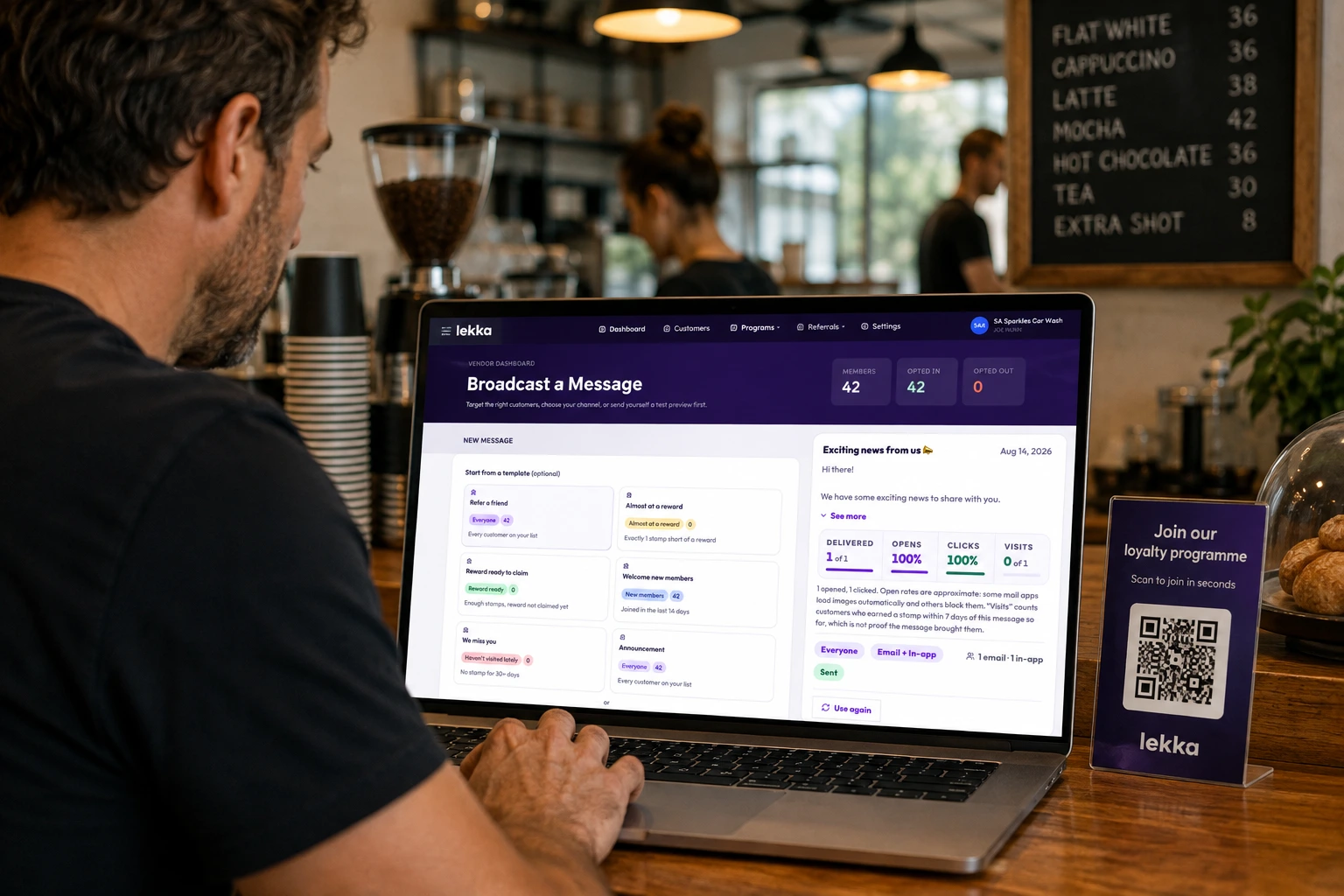
Lekka is a digital loyalty platform built specifically for South African independent businesses. There are no setup fees, no hardware requirements, and no per-transaction costs. Lekka takes no cut of your sales and runs completely separately from how you take payment, so your card machine and your processor stay exactly as they are. Customers join for free, and they never pay anything.
Every plan includes the QR stamp system, vendor dashboard, reward management, customer list and customer export. Paid plans add broadcasts, basic insights and a daily digest, and from Growth up you get custom branding, review canvassing, the refer a friend programme, advanced insights and team accounts at R25 per staff login, with a second site on Growth and up to five on Premium.
One thing worth saying plainly, because it is unusual: these are the totals payable. Lekka is not VAT registered, so there is no VAT to add on top. R249 is R249. It is worth checking the same question of anyone else you look at, because plan fees and transaction rates in this market are usually quoted excluding VAT, and 15 percent is a meaningful gap between the number you compare and the number you are billed.
How to calculate the return
A loyalty programme that costs R249 per month needs to generate roughly R250 in retained revenue to break even. That is less than one additional customer per month who would otherwise have gone somewhere else. At R499/month you need two. At scale with 100+ enrolled customers, even a 5% improvement in return rate covers the cost many times over.
The smarter question isn't "what does this cost?" but "how many customers do I need to retain to justify this?" For most businesses in the Lekka target market (coffee shops, salons, restaurants, retailers), that number is very low.
💡 Tip
Start on the free plan and run your programme for 30 days. If you reach 50 enrolled customers and are seeing repeat visits, you have proof it's working: then upgrade. There's no reason to pay for features you haven't tested yet.
The hidden cost nobody talks about
The biggest cost of a loyalty programme isn't the subscription. It's the reward itself. If you offer a free coffee after 10 stamps, you're giving away a R35–R45 product to every customer who completes a card. At a gross margin of 65%, that's roughly R12–R16 in real cost per completed card.
That's not a problem. It's the point. But it's worth knowing. Set your stamp threshold and reward value so the economics make sense for your margin, not just because a round number like 10 feels right.
The other hidden cost: loyalty that runs through your card machine
There are really only two ways to fund a loyalty programme, and the difference matters more than the monthly fee. You can pay a percentage of every loyal sale, which is how loyalty built into a card machine normally works. Or you can pay the cost of the reward itself, once, when a customer earns it. That is how a stamp programme works.
The difference is not just the size of the number, it is what the number tracks. A percentage reward tracks how much people spend, so your best, highest-spending regulars are the most expensive ones to keep. A stamp tracks how often they come back: one visit is one stamp, whether the customer buys a single coffee or a round for the table. If you succeed in getting your regulars to spend a bit more each time, which is usually the whole aim, the percentage bill goes up and the stamp bill does not.
It is also hidden in plain sight. A card machine provider's own cost calculator shows you the payments bill, the part that stays with your processor whatever you do about loyalty. The reward you fund sits on top of that figure, out of margin, and does not appear in it anywhere.
📌 Note
Yoco is the example most South African owners will know. Loyalty runs on its Plus plan at R249 a month, and the earn rate is a percentage the business chooses, typically 2 to 5 percent of the sale. Card transaction fees are separate, decline across turnover bands and differ by card type. Both the plan fee and the rates are published excluding VAT, so the real bill is 15 percent higher than the headline. Figures as published on yoco.com, August 2026. Rates change, so check the current ones and your own statement before you decide.
Which model works out better depends entirely on your numbers: what a reward costs you to make, what a customer typically spends on a visit that earns a stamp, how many stamps fill a card, and how many of those cards ever get finished. We have put the arithmetic on one page, with a calculator that works from the published rates rather than from our summary of them.