The South African small business loyalty market has changed. Two years ago, your options were paper stamp cards or an expensive enterprise platform built for retail chains. Now there are several digital loyalty products marketed specifically at independent businesses: some local, some imported from Australia and the UK.
That's broadly good news. But not all of them are the right fit for a South African coffee shop, salon, or restaurant. Some require hardware you have to buy, manage, and replace. Some charge in foreign currency. Some lock you behind a sales call before you can even see the pricing. Some require your customers to download yet another app.
Before you commit to any platform, ask these five questions. The answers will tell you most of what you need to know.
1. Does my customer need to download an app?
This is the most important question and the one most businesses don't ask until after they've launched. If customers need to download an app to join your loyalty programme, you will lose a significant portion of potential members at exactly the moment they're most likely to sign up: right after a good experience at your counter.
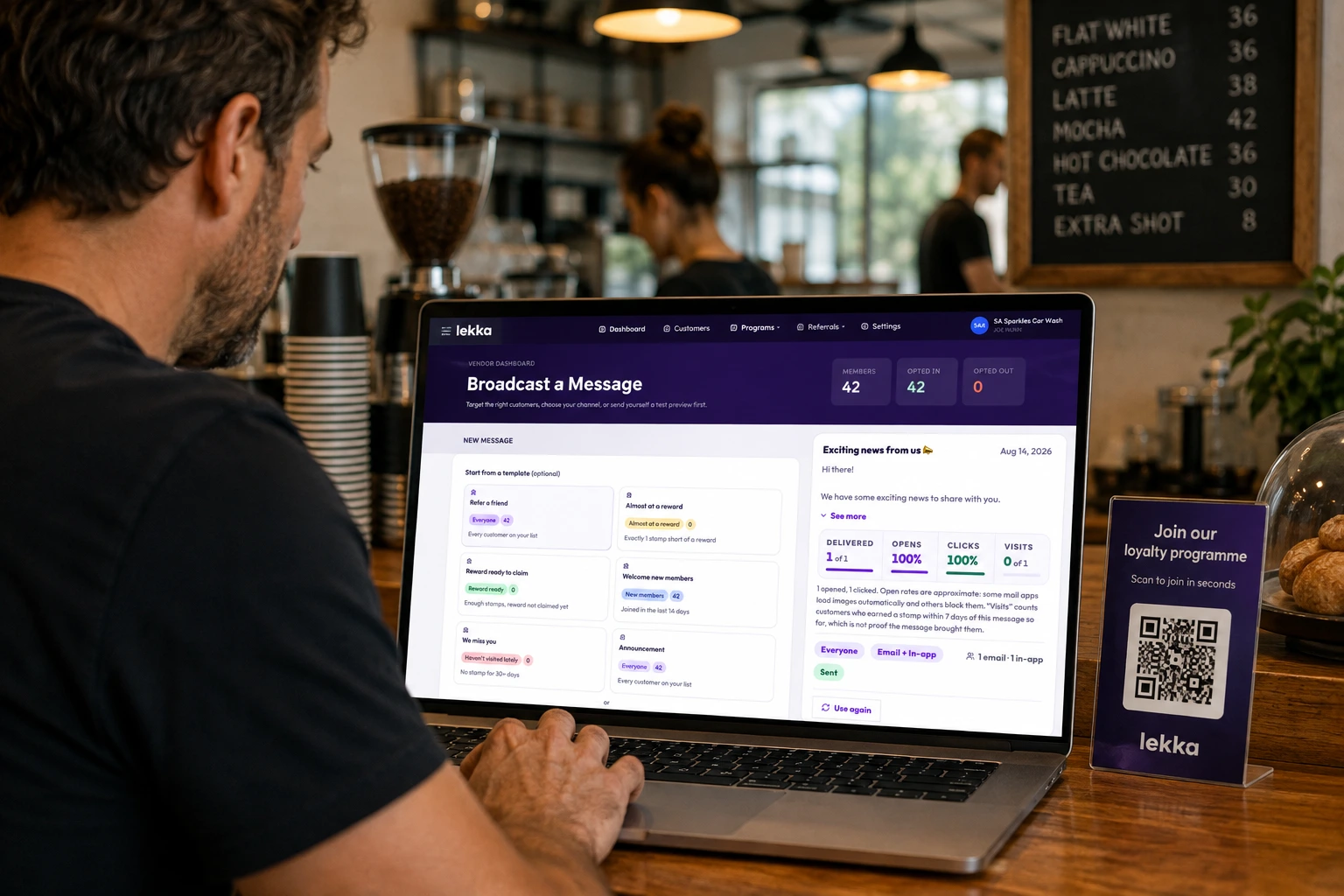
App adoption in South Africa is constrained by data costs, storage limits, and fatigue with the number of apps consumers are already managing. An independent coffee shop is not going to convince customers to install a new app. A browser-based programme that works from a QR code scan, with no download and no account setup beyond a name and email, removes all of that friction.
💡 Tip
Test this yourself before signing up. Visit the platform's demo or create a test account and go through the customer journey on your phone. If you hit an app store prompt, that's the moment your customers will drop off.
2. Is there any hardware involved?
Some loyalty platforms differentiate themselves with physical hardware: NFC pucks at the counter, proprietary physical stamp devices that customers press their phone against, keyring tags for customers who don't use smartphones. The hardware can feel impressive in a demo. In practice, it introduces risks that a pure-software solution doesn't.
Hardware gets lost. It breaks. It needs to be replaced. Shipping times from a UK or Australian supplier to a Cape Town café can run weeks. If the device that runs your loyalty programme breaks on a Friday afternoon, your programme is down until a replacement arrives. A QR code printed on a counter card has no such vulnerability. If it gets coffee spilled on it, you print another one in 30 seconds.
There's also an ongoing cost dimension. Hardware-dependent platforms typically charge a subscription on top of the hardware cost, and replacement devices are not always covered. Run the total cost of ownership calculation, not just the monthly subscription.
3. What is the pricing, in rands, including all fees?
Pricing opacity is surprisingly common in this market. Some platforms publish no pricing at all and require a sales call to get a quote. Some publish pricing only in Australian dollars or British pounds. Some have a base subscription fee but also charge a percentage of every reward redeemed: a transaction fee on top of a subscription.
For a South African small business, foreign currency pricing is a real problem. A platform that costs £29 per month sounds reasonable until you do the conversion: at current rates, that's over R650 per month before any transaction fees. When redemption transaction fees are added on top, a busy coffee shop running regular reward completions can face a total monthly cost that looks very different from the headline number.
The questions to ask: What is the monthly cost in rand? Are there setup fees? Are there per-transaction or per-redemption fees? What happens to the price if my customer base grows beyond a certain number? Are there costs to export my data if I leave?
4. Can I get started without talking to a salesperson?
A surprising number of loyalty platforms in this space are sales-gated. You fill in a form, someone calls you, they do a demo, they give you a price, you negotiate. For a large retail chain with a procurement team, this is normal. For a business owner running a salon or a coffee shop on their own, it is friction that adds days or weeks to a decision that should take 15 minutes.
Self-serve onboarding, where you can create an account, set up your programme, generate your QR code, and be live without speaking to anyone, is the right model for independent businesses. It respects your time, gives you control, and lets you test the product at your own pace before committing.
Sales-gated onboarding also tends to correlate with pricing opacity. If a platform won't show you the price until you talk to them, that's usually because the price varies based on negotiation, which means the vendor you talk to after you may get a better deal than the vendor you replace, or vice versa. Transparent, published pricing is a trust signal.
Free resource
Not sure what reward to offer?
The reward is the most important design decision in your loyalty programme. We've put together five proven reward ideas for South African independent businesses, with margin guidance and real examples.
See 5 reward ideasFree, no sign-up required
5. Is there local support and local context?
A loyalty platform built for Australian cafés or UK restaurants will market itself as globally relevant, and in a functional sense, the stamp mechanic is universal. But the support model, the billing currency, the case studies, the blog content, and the sales team are all designed for a different market.
When something goes wrong, and eventually something will go wrong, you want to be able to reach someone who understands South African business hours, South African data costs, South African consumer behaviour, and South African payment infrastructure. A platform headquartered in London or Sydney with no SA presence means you're emailing into a timezone that's 2–8 hours behind you, with support staff who may have never met an SA business owner.
Beyond support, local context matters for the product itself. The research on South African loyalty behaviour (the 85% participation rate, the demographics gap among under-25s, the preference for simple stamp programmes over complex points systems) should inform how the platform is designed. A platform that's been shaped by Australian or UK research will make different design decisions than one built by and for South Africans.
The honest summary
There are good digital loyalty products available to South African small businesses. The right one for you depends on your answers to these questions, and on being honest about what your customers will actually use. A technically sophisticated platform that requires an app download, charges in pounds, and needs a hardware device is harder to sell to your customers than a simple QR code that works in their browser, costs a flat rand fee, and needs nothing to ship.
The best loyalty programme is the one your customers actually join. Friction is the enemy of enrolment. Before signing up for anything, walk through the customer journey yourself, on your own phone, on a South African mobile network. That experience is what your customers will have, and it should be the thing that makes the decision.
☕ Real example
Infinity Coffee at Helderberg Nature Reserve in Somerset West launched their Lekka programme with a single QR code at the counter. No hardware, no app download, no transaction fees. In their first 17 days they achieved an 83% customer return rate, up from 30% in the same period the previous month.