Every restaurant owner knows the difference between a table of tourists who found you on TripAdvisor and a table of regulars who come every second Thursday. The regulars order confidently, they spend more, they bring people with them, and they advocate for you without being asked. The tourist table is a transaction. The regular table is a relationship.
The challenge for independent South African restaurants is that building a regular base is largely invisible work. There's no single lever to pull. But there are practical things you can do, and loyalty programmes are one of the most effective.
Why restaurants are harder than coffee shops for loyalty
Coffee shops benefit from daily or near-daily visit habits. A customer who gets a coffee on the way to work builds a stamp card fast. For a restaurant, where most people dine out once or twice a week at most, across multiple venues, the frequency is lower and the competition is broader.
This means the loyalty programme design matters more in a restaurant context. Set the threshold too high and it feels unattainable. Too low and the reward feels cheap. The goal is to reward the genuine regulars, the people who are already choosing you, without subsidising occasional diners who would have come anyway.
The local regular vs the tourist diner
South African restaurants, particularly in tourist-heavy areas like the Western Cape, face a split audience. Tourist traffic is high-spend but volatile. Local regulars are lower average spend but consistent and growing. A loyalty programme is almost entirely a tool for the local audience. Tourists won't complete an 8-stamp card. Your Thursday night regulars will.
This isn't a reason not to run a programme. It's a reason to think clearly about what you're trying to build. If your goal is more consistent midweek revenue from local customers, a loyalty programme is exactly the right tool.
Free resource
Not sure what reward to offer?
The reward is the most important design decision in your loyalty programme. We've put together five proven reward ideas for South African independent businesses, with margin guidance and real examples.
See 5 reward ideasFree, no sign-up required
Designing the right programme for a restaurant
For a restaurant, visit-based stamping (one stamp per visit regardless of spend) is the simplest and most effective mechanic. It rewards frequency, which is the behaviour you want to drive. Spend-based points systems are harder to manage, confuse customers, and rarely feel as satisfying as watching a stamp grid fill up.
Threshold: 8–10 visits for a meaningful reward works well for restaurants. At once-a-fortnight dining frequency, that's 4–5 months: achievable but not trivial. The reward should be something your regulars actually want: a complimentary starter, a bottle of wine, a free main course on a return visit.
💡 Tip
Consider a threshold of 8 rather than 10. Loyalty research consistently shows that when a programme feels within reach, engagement stays higher. Lowering from 10 to 8 cuts the completion timeline by 20%, and customers who complete their first card are significantly more likely to re-enrol.
Using broadcasts to fill slow nights
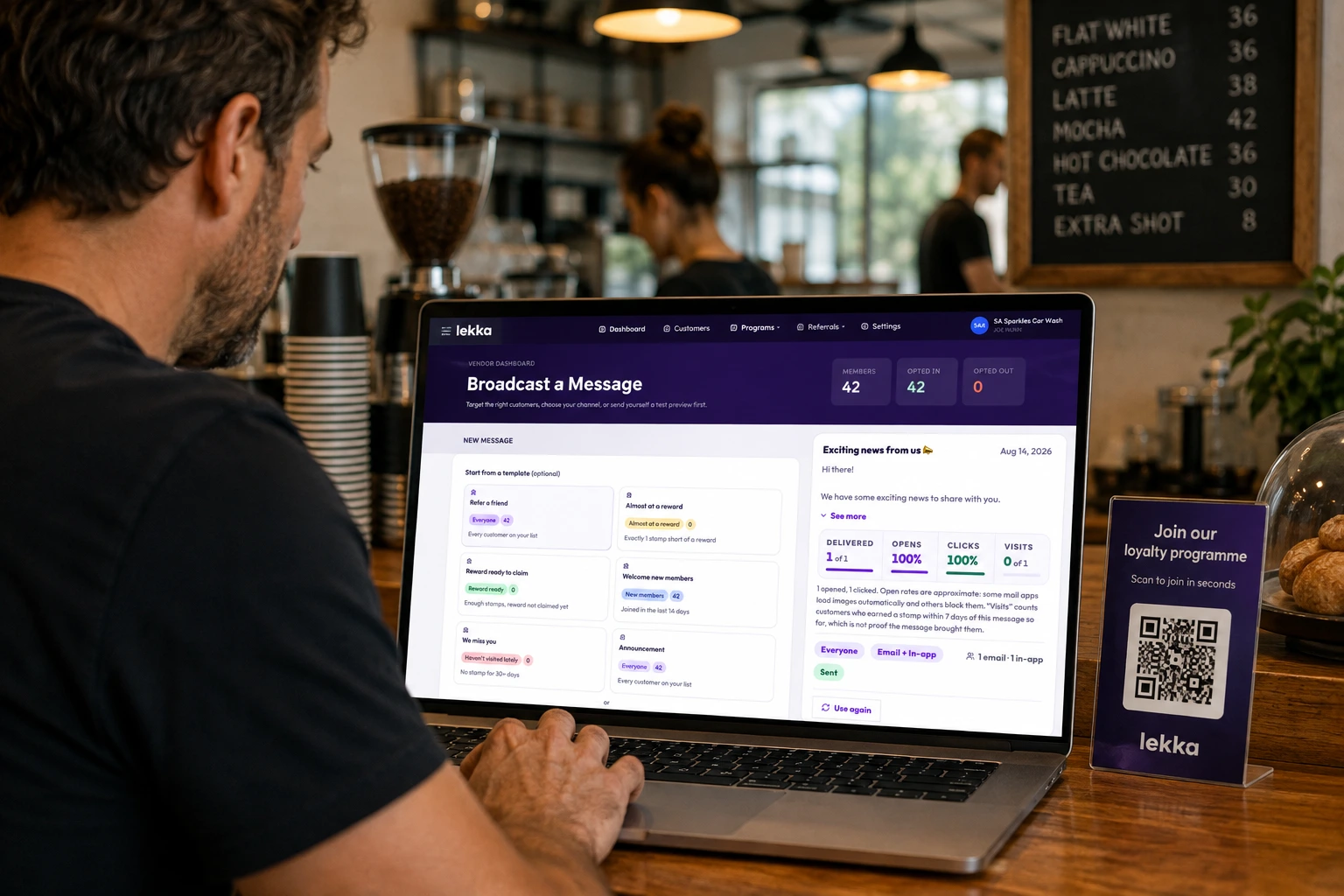
The most underused feature of any digital loyalty programme is the broadcast. Once you have 30–50 enrolled customers, you have a direct line to people who have already chosen your restaurant. A Tuesday afternoon message ("Quiet tonight, table for two available, come in for our lamb shank special") costs nothing and can fill a table that would otherwise stay empty.
This is not spam. These are people who opted in to hear from you when they joined your programme. Used judiciously, once or twice a week at most, it's one of the most effective marketing tools available to an independent restaurant with no advertising budget.
5 tactics for building restaurant regulars
- 1Put the QR code on your menus and table cards, not just at the till. Customers decide to join when they're settled and enjoying themselves, not when they're rushing to pay.
- 2Train floor staff to mention the programme naturally during the meal, not as a script at checkout. "Do you have a Lekka card? You'd earn a stamp tonight" is more effective than a printed card slipped into the bill folder.
- 3Set your reward to something with genuine perceived value. A R50 voucher off a R400 bill feels marginal. A free bottle of house wine or a complimentary dessert for two feels like an occasion.
- 4Use broadcasts during slow periods, not just to announce specials. Message your loyalty base when you have last-minute availability, an event, or something seasonal worth trying.
- 5Track who's close to a reward and give them a nudge. A customer on 7 of 8 stamps is worth a personal message: 'One more visit and your next dinner includes a complimentary starter.' That kind of personalisation builds the relationship.
The data restaurants are missing
Most independent restaurants have no idea which of their customers are regulars. They recognise faces, but they don't know names, visit frequency, or what's driving repeat visits. A digital loyalty programme changes that. After 90 days, you have real data: who your most loyal customers are, how often they come, and, if you change your programme, whether the change had any effect.
That data is the foundation of everything else. You can't improve what you can't measure. A paper stamp card gives you nothing. A digital one gives you a customer list with visit history.