Most small business owners know they should have a loyalty programme. Fewer than a third actually have one, and of those, most are still using paper stamp cards that get lost, forgotten, or left at home. This guide walks through exactly how to set up a digital loyalty programme for your South African small business, from the first decision to your first redemption.
The whole process takes about 30 minutes to set up and one week to get meaningful traction. You do not need a developer, a designer, or a big marketing budget.
Free resource
Not sure what reward to offer?
The reward is the most important design decision in your loyalty programme. We've put together five proven reward ideas for South African independent businesses, with margin guidance and real examples.
See 5 reward ideasFree, no sign-up required
Step 1: Decide what your reward will be
Your reward is the whole reason customers join. Everything else, the app, the QR code, the stamp target, is infrastructure. The reward is the product. Get this wrong and no amount of marketing fixes it.
The most effective rewards in South Africa are free versions of what you already sell. A free flat white. A free blowdry. A free lunch. This works for three reasons: the cost to you is close to your variable cost (not your retail price), the customer already knows they want it, and there is no perceived catch.
- ✓Coffee shops: a free coffee of any size is the gold standard. "Your 10th coffee is on us" is immediately understood by every customer.
- ✓Hair salons and barbers: a free treatment, blowdry, or beard trim after a set number of cuts. The service model makes this easy: the appointment cadence already drives repeat visits.
- ✓Restaurants: a free starter, dessert, or R50-R100 off the bill. Discount-off-bill tends to work better than a specific free item because it applies regardless of what the customer orders.
- ✓Retail: a percentage off or a fixed-rand discount voucher. Keep it simple: "R50 off your next purchase" is clearer than a points-per-rand calculation.
💡 Tip
Price your reward at roughly 10-15% of the total spend required to earn it. If your coffee is R40 and you want 10 stamps, the customer spends R400 to earn a R40 reward, a 10% return. That is the sweet spot. Below 8% feels stingy. Above 20% you are giving away margin you cannot sustain.
Step 2: Set your stamp target
The stamp target is the number of visits required to earn the reward. Set it too high and customers lose interest before they get there. Set it too low and you eat margin without building genuine habit.
The research is consistent: 6 to 10 stamps is the effective range for most independent businesses. Below 6 and customers do not feel they have earned anything meaningful. Above 10 and the reward starts feeling unreachable for less frequent visitors.
- ✓Daily habit businesses (coffee shops, lunch spots): 8 to 10 stamps. These customers visit multiple times a week, so even 10 stamps is achievable within 2-3 weeks.
- ✓Weekly habit businesses (gyms, barbers, some cafes): 6 to 8 stamps. A monthly-ish visitor will take 6-8 weeks to complete a card at 6 stamps: far enough away to feel earned, close enough to feel achievable.
- ✓Occasional visit businesses (restaurants, some salons): 5 to 7 stamps. A customer who visits monthly needs to see the reward within 5-6 months or they will disengage.
📌 Note
Infinity Coffee in Somerset West runs a 10-stamp programme for a free flat white. In their first 17 days on Lekka, 24 customers joined and the programme achieved an 83% customer return rate, up 53 percentage points from the month before.
Step 3: Set up your digital programme
Once you know your reward and your stamp target, you need the infrastructure. The decision between paper and digital matters more than most business owners realise. Paper stamp cards get lost, cannot be tracked, and give you zero data about who your regulars are. Digital programmes fix all three problems.
With Lekka, setup takes under 10 minutes. You create your business profile, set your programme name, choose your stamp target and reward description, and generate your QR code. Your customers never need to download an app. They scan the QR code on their phone browser, tap to join, and their stamp card is live.
Live demo
Corner Cafe
Somerset West, CT
Your reward
Free flat white
This is exactly what your customers experience when they scan your QR code.
Step 4: Place your QR code where customers will see it
Your QR code is your sign-up mechanism. Where you place it determines how many customers see it and how many join. Most businesses underestimate how much placement matters.
- ✓Counter card or tent: printed and placed on your counter or till point. This is the highest-converting placement because customers are standing there with their phone anyway.
- ✓Table cards: for restaurants and cafes where customers sit. A small card on each table with the QR code and a one-line explanation, such as "join our loyalty programme, your 8th coffee is free," works well.
- ✓Printed receipt: if you print receipts, adding the QR code and a short line about the programme to every receipt means every customer who pays sees it.
- ✓Window sticker: visible from outside, useful for converting passing traffic who are deciding whether to come in.
- ✓Instagram story: a weekly reminder to your existing followers. Many of your regulars follow you but may not know you have a loyalty programme.
Step 5: Tell every customer personally for the first week
This is the step most business owners skip, and it is the most important one. A QR code on a counter is passive. A person saying "we have just launched a loyalty programme, scan this and your 10th coffee is free" converts at a completely different rate.
Train every staff member to mention the programme at the point of payment for the first week. Not a hard sell, just a warm, one-line mention. "We have just launched a loyalty stamp card, scan this QR code and you get a free coffee after 10 visits." Most customers say yes immediately.
💡 Tip
Give your first stamp automatically to every customer who signs up. It removes the cold-start problem: they are immediately 1 out of 10 of the way there before their next visit. This single change consistently improves programme completion rates.
Step 6: Use broadcasts when you have something to say
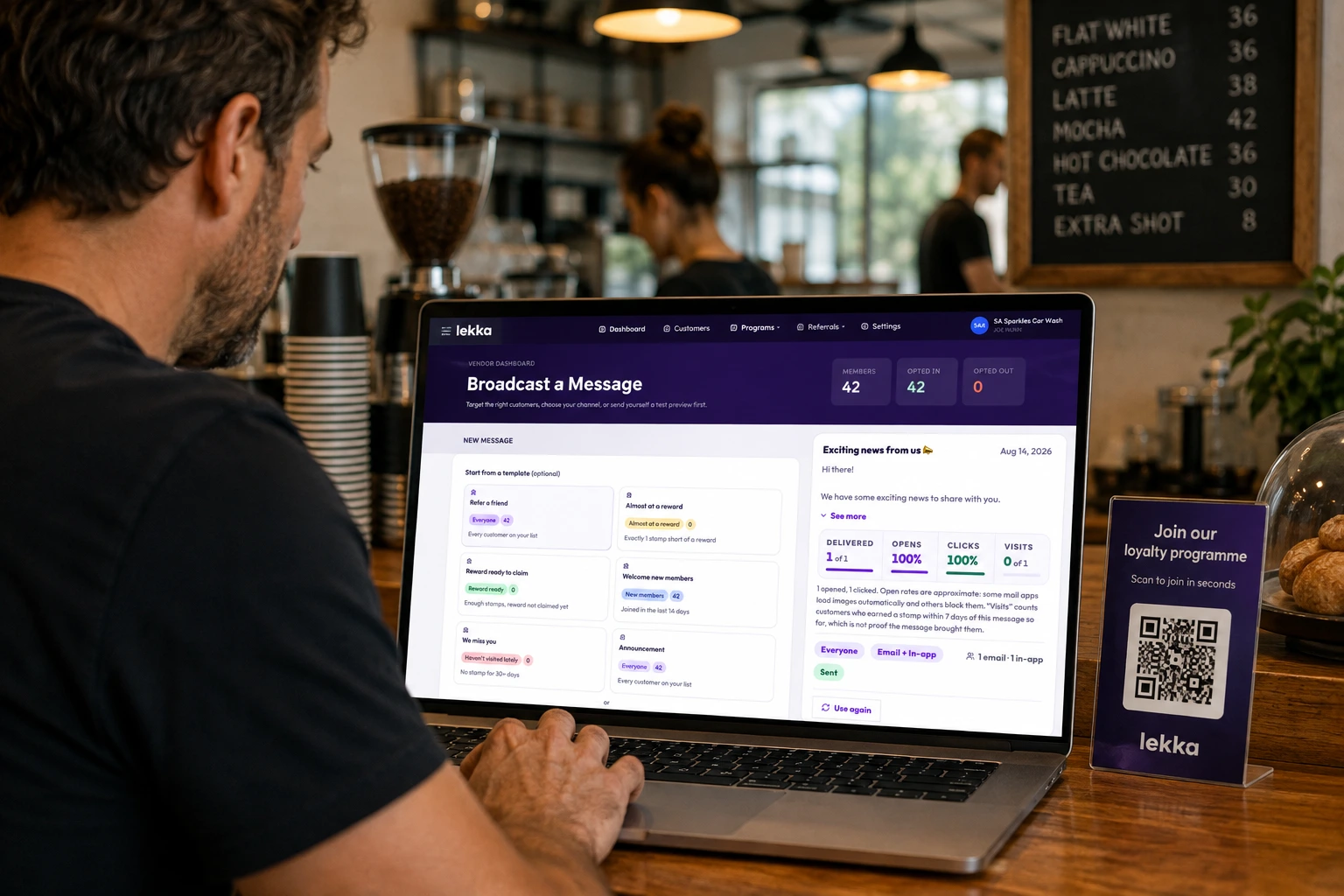
One of the biggest advantages of a digital loyalty programme over paper is the direct communication channel. Once customers join your programme, you can send them a message directly: a special, an event, a new menu item, a quiet-day deal.
This is not email marketing to a cold list. These are customers who have actively chosen to support your business, who have given you their contact details voluntarily, and who are already in the habit of spending money with you. Open rates and conversion rates are significantly higher than any paid advertising channel.
The rule for broadcasts: only send when you have something genuinely worth saying. One message a week maximum. A quiet Tuesday special, a new seasonal menu, a last-minute slot that opened up. Customers who signed up for a loyalty programme have a high tolerance for relevant messages and a low tolerance for noise.
How long until you see results?
In the first week, expect to sign up between 10 and 30 customers if you mention the programme verbally at the till. By week three, you will start seeing repeat visits from programme members: customers who might otherwise have gone somewhere else are coming back because they are building towards something.
The clearest signal that your programme is working is not the number of sign-ups. It is the return rate. A healthy loyalty programme should meaningfully increase the percentage of customers who come back within 30 days. That is the number to watch.
South Africa has one of the most loyalty-engaged consumer markets in the world: 85% of economically active consumers actively use loyalty programmes. Your customers are already primed to join one. The businesses that win are the ones who make it easy.