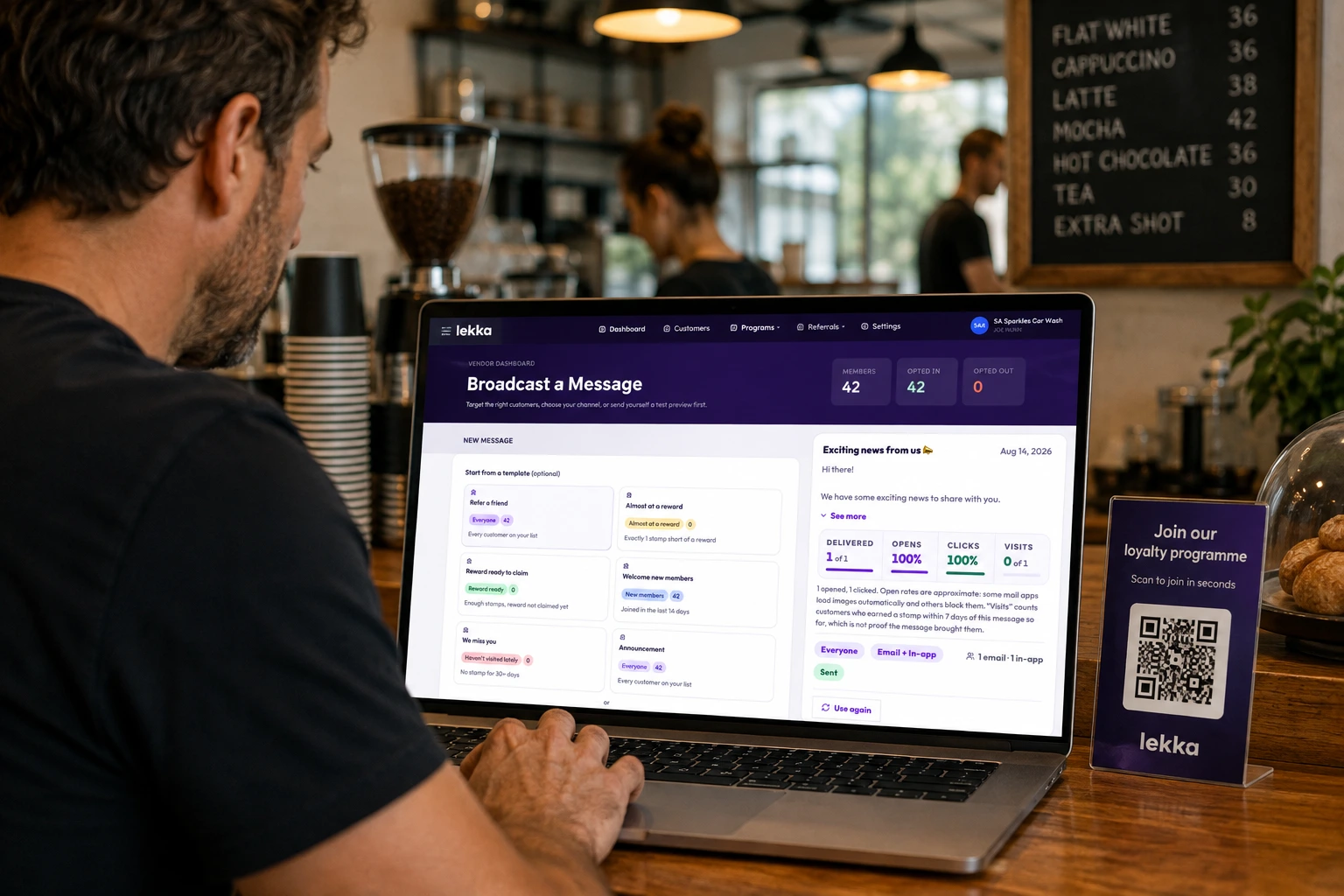
Picture two loyalty programmes for the same R45 flat white. One gives 7.5% cashback, so the customer earns about R3.40 back per cup. The other is a stamp card: buy nine, get the tenth free. On a spreadsheet they cost a coffee shop roughly the same. In a customer's head, they are not even close.
The difference is not the rand value. It is the psychology. And it has been studied for decades, often using the exact thing you are deciding about: a coffee loyalty card. Here is what the research actually says, and what it means for your shop.
Two different machines
Cashback and stamp cards look like cousins, but they are built to do different jobs. Cashback is a quiet discount. It shaves a few percent off a purchase the customer was probably going to make anyway, then drops the money into a balance they rarely think about. A stamp card is a goal. It gives the customer something to finish, a visible run of progress, and a reward waiting at the end.
One nudges the price down slightly. The other changes behaviour. That distinction is the whole story.
The goal that pulls people back
In 2006, three researchers (Ran Kivetz, Oleg Urminsky and Yuhuang Zheng) studied a real café loyalty card: buy ten coffees, get one free. They found that customers bought coffee more frequently the closer they got to the free one. The reward was not changing. The distance to it was. This is the goal-gradient effect: the nearer the finish line, the harder people push.
They found something else, too. Customers eased off right after claiming a reward, then sped up again as they approached the next one. A stamp card does not just sell one extra coffee. It sets up a repeating cycle of acceleration, which is exactly what a small business wants from a regular.
📌 Note
Cashback has no finish line. There is no 'one more and I get the free one' moment, because there is no free one. The customer is never close to anything, so there is nothing to accelerate towards.
Live demo
Corner Cafe
Somerset West, CT
Your reward
Free flat white
This is the goal your customer is working towards. Watch the progress fill up, and notice the pull of that last empty slot.
Why 'free' hits harder than 'money off'
There is a special kind of magic in the word free, and it is not rational. In a 2007 study published in Marketing Science (Kristina Shampanier, Nina Mazar and Dan Ariely), people chose between a cheap chocolate and a premium one at various prices. When the cheap chocolate dropped to free, demand for it jumped far more than the small price change should explain. Free is not just a low price. People treat it as a different category altogether.
A free coffee lands as free. Cashback lands as a small discount, even when the rand value is similar. R3.40 back is forgettable. A whole free flat white feels like a gift. Same maths on your side, a very different feeling on theirs.
Cashback disappears. A free coffee doesn't.
Richard Thaler won a Nobel Prize partly for showing that people do not treat money as one big interchangeable pool. We sort it into mental accounts. His 1985 work on mental accounting helps explain why a few rands of cashback simply dissolve into a customer's general spending. It is money, so it goes where money goes, and it is quickly forgotten.
A free coffee cannot dissolve. It is a specific thing, claimed at a specific moment, that the customer would not otherwise have bought. It becomes a small event: a treat, a little story, a reason they remember your shop. Cashback is a number. A reward is a memory.
The reward you earn feels better than the cash
You might assume a customer would always prefer cash, because cash is flexible. The research says otherwise. In 2002, Ran Kivetz and Itamar Simonson found that the more effort a loyalty programme asks for, the more people prefer an indulgent reward over a practical one. Earning something gives people permission to enjoy it without guilt.
A free coffee is a small luxury the customer has earned the right to enjoy. Cashback is just money they feel they ought to put towards something sensible. After nine visits, the treat is the stronger pull, not the cash.
☕ Real example
Here is the part that makes a coffee shop owner smile. That free coffee feels like a R45 gift to the customer, but it costs you only the ingredients, maybe R12. Cashback gives away real rands on every sale, forever. The stamp card hands over a big-feeling reward for a small real cost, and only once a customer has already come back nine times.
The honest part: when cashback wins
Stamps are not always the answer, and it would be dishonest to pretend they are. Cashback genuinely suits some businesses. If you sell high-ticket items with fat margins, a percentage back can be large enough to notice, and a 'free one' may not fit how people buy from you. If every customer pays by card on the same device, cashback can run quietly in the background.
For thin-margin, high-frequency businesses such as coffee shops, bakeries, salons and lunch spots, the picture flips. Small cashback is too small to feel, and giving away a slice of every sale is a real dent in a tight margin. That is the territory stamp cards were built for.
What this means for your shop
- ✓If customers visit often and your margins are tight, a stamp card will almost always out-pull cashback, for less real cost.
- ✓Set a reward people actually want. A free version of what they already buy beats a small discount every time.
- ✓Pick a target customers can reach. The goal-gradient effect only works if the finish line feels close enough to chase.
- ✓Protect your margin. You pay out only when a customer has earned the reward, not on every single sale.
Run the numbers for your shop
Lekka is a stamp-and-reward programme built for thin-margin South African businesses. Flat monthly pricing, no per-transaction fees, and no cut of your sales. See what it would cost you.
See pricingFree for your first 50 customers
The studies behind this
We do not make up the psychology. Here are the original papers, if you would like to read them yourself.