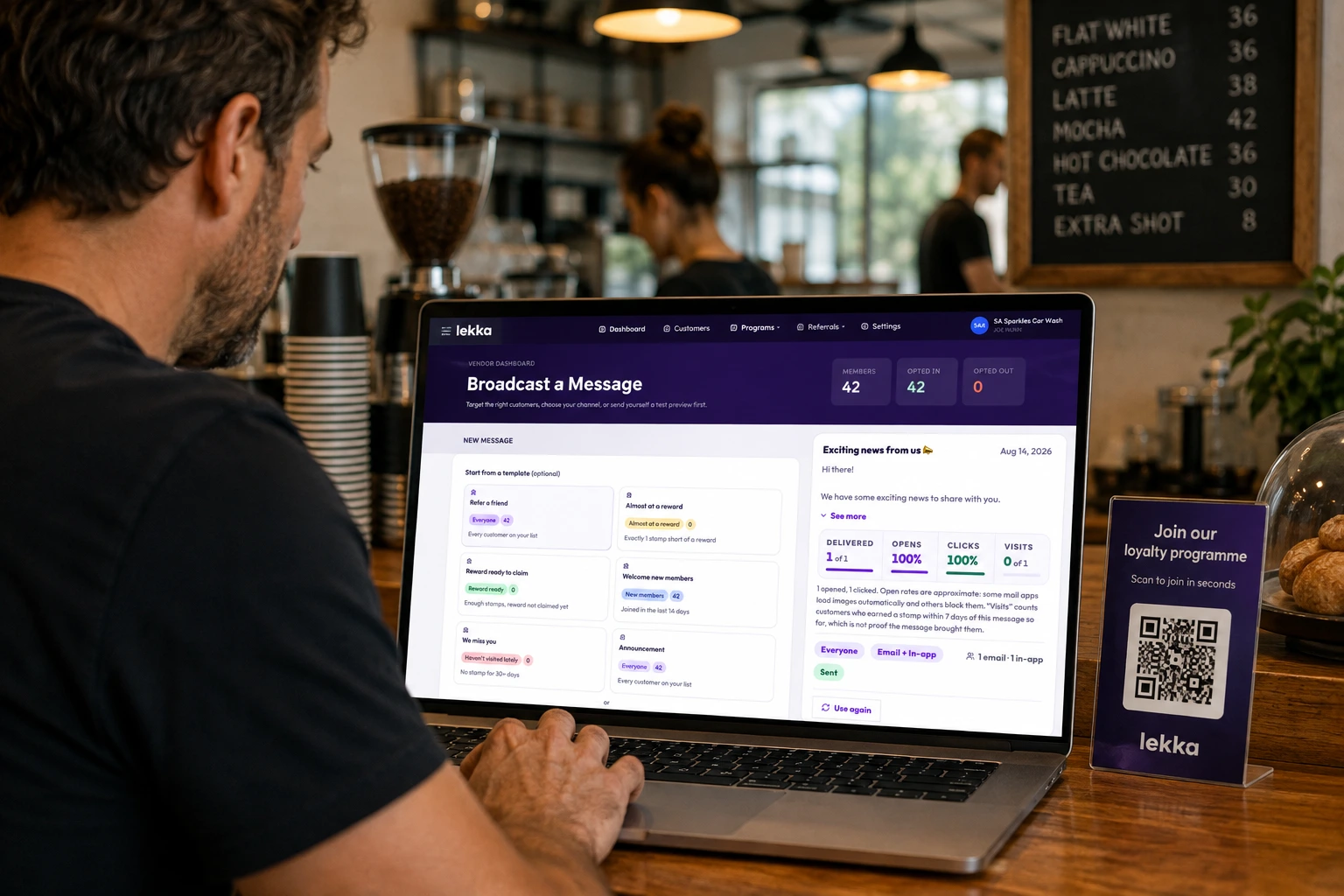
Getting someone through the door the first time is the expensive part. The second, fifth and twentieth visit is where an independent business actually makes its money, and that is a communication problem more than a marketing one.
Most owners know this. Very few send anything. Not because they do not want to, but because every tool built for the job starts by asking for things a small business does not have lying around: a clean mailing list, a template, a designer, and a free afternoon.
So we built the messaging into the loyalty card instead of alongside it. If you are already stamping customers, the hard parts are done.
You already have the list
It knows who joined in the last two weeks and has not been back. It knows who is one stamp short of a reward. It knows who has earned a reward and not come in to claim it. It knows who used to come every week and has not been seen for a month. Those are the four or five conversations worth having, and they are already sorted for you.
☕ Real example
Someone one stamp away from a free coffee is a very different person from someone who has not visited since March. One needs a nudge, the other needs a reason to come back. Sending both the same message is why most small business marketing gets ignored.
No templates to build
- ✓Refer a friend, with each customer's own sharing link filled in automatically
- ✓Almost at a reward, for the people one stamp short
- ✓Reward ready to claim, for anyone sitting on an unclaimed reward
- ✓Welcome new members, for people who joined in the last two weeks
- ✓We miss you, for regulars who have gone quiet
- ✓Announcement, for news, hours or anything else
Edit the wording if you want to, or send it as it stands. You can add a promo code, drop in a customer's first name, and see exactly what will land in their inbox before it goes anywhere. There is no HTML, no drag and drop, and no branding step, because your business name and colours are already set up.
You can add one photograph if you want to. It sits at the top of the email and appears as a thumbnail on the in-app message, and it is resized and compressed for you, so a picture straight off your phone will not turn into a message nobody can load.
And you do not have to find the words
Type the gist in a sentence or two, the way you would tell a member of staff. Sunday special, kids eat free, bring the family. You get back a subject line and a short message written the way an owner talks to a regular, in South African English, using your own business details. It arrives in the composer as a draft, so you can change every word before anything is sent.
It invents nothing. If your note does not mention a price, a date or an offer, neither will the message, because a plausible detail you never asked for is worse than a vague one you did.
📌 Note
Every paid plan includes three drafts a month, and beyond that they are sold in packs, starting at R49 for ten. Writing the message yourself costs nothing and always will.
Email and in-app, in one send
You can also send only in-app when something is minor and does not warrant an inbox, which is a good habit and one most email tools cannot offer you at all.
The number on the button is the number that receives it
Before you send, the screen shows how many customers will actually receive the message, not how many exist in that group. Anyone who received a broadcast from you in the last seven days is held back. Anyone who has turned off offers is excluded. Both deductions are shown to you, with the reason, before you press anything.
📌 Note
A message reaching fewer people than you expected is annoying. Finding that out afterwards, from an empty inbox, is worse. So the count, the confirmation step and the record afterwards all report the same honest number.
You find out whether it worked
Open figures carry a caveat most tools leave out. Some mail apps load images automatically and register an open nobody performed, and others block them and hide real ones, so that number is a guide rather than a count. Where the same message also went out in the app, you get something better beside it: a read there means a person opened it, because there is no image to prefetch and nothing to infer.
The one worth watching is different. Because the messaging lives inside your loyalty programme, we can also count how many of the people you messaged came in and collected a stamp within the following seven days. A general email tool cannot tell you that, because it has never seen your till.
We are careful about what that number means. It counts visits that happened after the message, which is not proof the message caused them. Regulars come in anyway. Watched over a few sends, though, it is the closest thing a small business has to knowing whether the effort was worth it.
Every send you have made is kept in one table, so you can sort by open rate and see which subject lines your customers actually respond to. Once you have a few sends behind you, each new one is measured against your own average rather than against a published industry figure, which is the only comparison that means anything when the list is your own regulars.
Built so you cannot annoy people
- ✓Each customer receives at most one broadcast a week from you, whatever you send
- ✓Every email carries a one-tap unsubscribe that stops offers without touching their stamps or rewards
- ✓Customers choose separately whether they want offers by email, in the app, both or neither
- ✓Turning off offers never affects reward notifications, so nobody loses what they earned
What it replaces
Broadcasts are included on Lekka's paid plans. Pricing is a flat monthly fee based on how many regulars you have, with no per-transaction cut, so a good month is entirely yours.
Get started
Start talking to your regulars
Every paid plan includes broadcasts, the six ready-written messages, the assistant and the reporting that tells you whether any of it worked. Pick the plan that matches the number of regulars you have.
See plansFlat monthly fee · no per-transaction fees · no contract